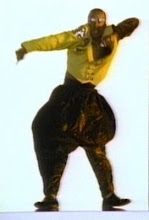
An incredible thing happened to me the other day, as I was walking down the street. It was early in the morning, and I was the only one about. With the dew on the leaves, and the clouds still all fresh and pink, it could well have been the first day in creation, and I could have been the first cat who ever wore balloon pants affixed with a leather cummerbund, as I sauntered down that street.
As I turned a corner, I happened to pass by a young dude. He looked like he was in his teens, he had a shock of fluffy blond hair on the top of his head, a red shirt, and a pair of light-coloured jeans on.
I passed him and went along my merry way. I kept walking down the street and after about 20 metres, I made a short-cut through a narrow laneway. Then something very messed up happened: the same boy walked passed me again in the lane way.
For a few second there, my mind was a mess of panicking contortions. There was no way this boy could have made it around the block in the few seconds since I had passed him before. And not only were these people identical in every way, but they were also wearing exactly the same thing.
Of course, after just a few seconds, using the powers of logic that I am so well known for, I worked out that these people were probably twins, and not clones. And since they were funky teen twins (or 'tweenins' as you might consider calling them), they probably (a) had a lot of sibling rivalry, which explained why they didn’t want to walk together, and (b) on their way to school, which was why they were both walking in the same direction.
Another problem solved. But it got me thinking. Just like life, grammar is full of confusing look-alikes that not only look just the same, but almost do exactly the same thing too. So when you come across them in a sentence, you can often find yourself asking ‘WTF? What’s the actual difference between these two words?’
Take for example, the difference between ‘practise’ and ‘practice.’
You might look at these two words and at first you’d be all like ‘Oh, the reason that one of these has an s, and one of these has a c, is because one is an American spelling, and one is a British spelling’ You’d be wrong. In the UK, ‘practice’ and ‘practise’ are both used, while in the US, only ‘practice’ is used. Which kind of doesn’t help at all.
So, just say you don’t live in the wide, glorious land of the United States. Let's just say that although you’ve applied through several channels, you can’t get a work visa. What do you do next?
In the UK and its sexy colony, Australia, ‘practice’ is a noun, while ‘practise’ is a verb. For example:
Dr Wright’s a pretty good doctor. His medical practice is just down the road.
I need to practise my capoeira, so I can become a dancing warrior.
Are you a practising Catholic?
Meanwhile, at some stage in history, the US decided this was a pretty small detail, and that they were pretty busy and couldn’t really be fucked, and started using ‘practice’ for everything.
It's most likely that there are some cases where North Americans might try to stick to what’s technically correct, but when you are on your tourist's visa in the US, pursuing research into the many practices that Americans engage in, and noting it all down in your field notes, MC Grammar recommends that it’s probably best to stick to that spelling in your field report.
Friday, 13 August 2010

Tuesday, 20 July 2010
Back to the recent past! 'Used to' and 'use to'
This is Amy.

Amy made a terrible mistake that has to do with the internet fridge.
You see, around 2003, Amy had a lot of money. She had been saving up her wages for years, because she had a feeling that a major technological breakthrough was about to burst out of the dull mould of all that had come before, such as mini-disk players, or the 1969 h316 computer, which cost $10,000 US and could only store recipes.
And then, there it was: the internet fridge. It was breathtaking. It had so many features – it had the internet, obviously, but it also had a computerised notepad, where people could write messages to each other like ‘get milk’ instead of just writing a regular note. Photos of the happy family that owned the internet fridge could also be flashed in a slide show sequence, instead of just putting regular photos up on the fridge. It had so many features. And in addition to that, it was also a fridge, where food could be stored, just like a regular fridge. That was enough for Amy. She knew that this was the technological moment that she had been waiting for. And she had also saved $15,000, which was what the internet fridge cost.
And then, twelve months later, Amy heard talk of something called an 'iPod'. Suddenly, everyone was using one, revelling in the fact that they no longer had to lumber around with CD players jammed in their pants, or that they would have buy complicated walkman-pouches so they could play their single CD over and over again, until they could get home to play it. And they revelled in how they could store all the music they owned in this tiny machine. Amy tried to keep talking up the merits of the internet fridge, but no one wanted to listen any more. In fact, they couldn’t hear her at all, because they were all listening to their iPods, which had cost a mere $500.
Poor Amy. Because of her bad decision, she found herself trapped in the recent past. She suddenly belonged to a time in the past that wasn’t too distant, but was just outdated enough to push her out of the present. This is just like our grammar spotlight today, and the dilemma of used to and use to.
These are two terms are trapped in a swampy marsh of the past, but serve different functions. What is the difference between these two terms? Is there a difference? Step into my funky tardis and let’s find out.
These terms may look the same, but they are used for describing different time periods.
As you may know, the word use is a verb, and the past tense of use is used.
The term used to is for when you’re talking about repeated actions or events that happened a long time ago, but have now stopped.
When I was single, I used to spend my weekends writing complaint letters to David Jones.
You can also use it for actions that you once did a lot, but now don’t do as much.
We used to go out all the time.
This implies you may still go out sometimes, but not as often as before.
You say use to when it follows did or didn’t. For example,
Didn’t you use to type out swear words with your label maker and stick them to pigeons?
I didn’t use to grow a moustache, but when I got dumped for the 36th time I changed my mind.
Did you use to ride the monster truck?
In these sorts of sentences, the action (typing, growing a beard, riding the monster truck) are not completely in the past, and they may not have happened all that long ago – in fact there’s a chance they have escaped into the present, and may even career into the future like a drunk on a hoverboard. For this reason, we use the present tense, use. Just to be on the safe side. MC Grammar thinks you should always be safe. I don’t want to have to meet your mother’s eye and tell her what happened to you out there when you tried to describe something that was only in the recent past, and got confused. Don’t put me in that situation.
This might all seem hard to follow, but there’s a very simple way of remembering how to go about things. If the words did or didn’t are in the sentence, then you say use. If did or didn’t aren’t there, then you say used to. This is the simplest way of working this out, and knowing exactly what time period you're talking about.

Amy made a terrible mistake that has to do with the internet fridge.
You see, around 2003, Amy had a lot of money. She had been saving up her wages for years, because she had a feeling that a major technological breakthrough was about to burst out of the dull mould of all that had come before, such as mini-disk players, or the 1969 h316 computer, which cost $10,000 US and could only store recipes.
And then, there it was: the internet fridge. It was breathtaking. It had so many features – it had the internet, obviously, but it also had a computerised notepad, where people could write messages to each other like ‘get milk’ instead of just writing a regular note. Photos of the happy family that owned the internet fridge could also be flashed in a slide show sequence, instead of just putting regular photos up on the fridge. It had so many features. And in addition to that, it was also a fridge, where food could be stored, just like a regular fridge. That was enough for Amy. She knew that this was the technological moment that she had been waiting for. And she had also saved $15,000, which was what the internet fridge cost.
And then, twelve months later, Amy heard talk of something called an 'iPod'. Suddenly, everyone was using one, revelling in the fact that they no longer had to lumber around with CD players jammed in their pants, or that they would have buy complicated walkman-pouches so they could play their single CD over and over again, until they could get home to play it. And they revelled in how they could store all the music they owned in this tiny machine. Amy tried to keep talking up the merits of the internet fridge, but no one wanted to listen any more. In fact, they couldn’t hear her at all, because they were all listening to their iPods, which had cost a mere $500.
Poor Amy. Because of her bad decision, she found herself trapped in the recent past. She suddenly belonged to a time in the past that wasn’t too distant, but was just outdated enough to push her out of the present. This is just like our grammar spotlight today, and the dilemma of used to and use to.
These are two terms are trapped in a swampy marsh of the past, but serve different functions. What is the difference between these two terms? Is there a difference? Step into my funky tardis and let’s find out.
These terms may look the same, but they are used for describing different time periods.
As you may know, the word use is a verb, and the past tense of use is used.
The term used to is for when you’re talking about repeated actions or events that happened a long time ago, but have now stopped.
When I was single, I used to spend my weekends writing complaint letters to David Jones.
You can also use it for actions that you once did a lot, but now don’t do as much.
We used to go out all the time.
This implies you may still go out sometimes, but not as often as before.
You say use to when it follows did or didn’t. For example,
Didn’t you use to type out swear words with your label maker and stick them to pigeons?
I didn’t use to grow a moustache, but when I got dumped for the 36th time I changed my mind.
Did you use to ride the monster truck?
In these sorts of sentences, the action (typing, growing a beard, riding the monster truck) are not completely in the past, and they may not have happened all that long ago – in fact there’s a chance they have escaped into the present, and may even career into the future like a drunk on a hoverboard. For this reason, we use the present tense, use. Just to be on the safe side. MC Grammar thinks you should always be safe. I don’t want to have to meet your mother’s eye and tell her what happened to you out there when you tried to describe something that was only in the recent past, and got confused. Don’t put me in that situation.
This might all seem hard to follow, but there’s a very simple way of remembering how to go about things. If the words did or didn’t are in the sentence, then you say use. If did or didn’t aren’t there, then you say used to. This is the simplest way of working this out, and knowing exactly what time period you're talking about.
Sunday, 27 June 2010
When apostrophes go bad: Do's and Don'ts
Because of MC Grammar, you basically know everything now. You know how to change a light bulb, and what sort of light bulb goes into an IKEA lamp. You know how to unscrew a fluorescent light bulb and also what wattage goes into a fluorescent light bulb.
And you also know all about apostrophes. You know that an apostrophe either indicates possession, such as Jane’s hat, or indicates a shortening of the word is or has, like Jane’s happy or Jane’s already left. When there is no apostrophe, it means that the ‘s’ is only there to show that there is more than one of something. You know that saying The kings come in splendour is a very different to saying The King’s come in splendour. Because one is plural and one is singular.
But did you know that it’s not all as simple as all that? Just when you thought grammar was simple, the real world has to interfere and fuck up your shit. This brings us to the debacle of Do’s and Don’ts
What’s happening with this term? Firstly, it’s inconsistent: the do has an apostrophe before the s but the don’t doesn’t. Secondly, why does the do have an apostrophe at all? It’s NOT possessive, is it? It doesn’t ‘own’ anything in the sentence, does it? No, it doesn’t.
But believe it or not, this is how it has to be. Why? For no other reason than the fact that it looks weird without it. It looks like ‘dos’, Spanish for ‘two’. It looks like you tried to write ‘does’ and failed. It looks like a whole other word, and this reason, and this reason only, it has an apostrophe in it.
And take a look at its partner in crime, don’ts. Don’ts won’t even tow the line for consistency’s sake and become don’t’s. Why? yep, you know it – because it that looks weird too. There are too many apostrophes (two), so the final result is that Do’s and don’ts is one of the biggest outlaws of grammar, and there’s nothing that any of us can do about it, but curse and shake our fists.
So how does it get away with it? Believe it or not, because it’s more correct than all the other options, and makes more sense. Let’s remember, the whole point of grammar isn’t actually to be correct for the sake of being correct, it’s to make sense, and to communicate to the widest audience possible. In this case, ‘Do’s and Don’ts’ is correct by association, meaning that because the other options are so confusing, it’s won by default. It’s like a handsome outlaw: you know it’s a murderous felon, but who can resist those dark locks and symmetrical jaw?
A word of caution though: in most other cases, you should always stop and pause for reflection before proceeding with an apostrophe. An apostrophe is like a beautiful woman or man that you meet at a bar. Sure, you’re knocked sideways by their longish hair, dyed criminally blond and almost pitch black at the roots, and the sensual darkish colouring just below their eyes that gives a hint of Mediterranean blood via Poland or Northern Italy, but don’t just dive in – get a good look at them! Is that intriguing peroxided hair and enticing dark roots just a result of the fact that they originally set out to be a glamour model, then sunk into the seamy world of hard drugs? And are those bags under their eyes just a result of Hepatitis B?
In the same way, when it comes to apostrophes, you need to ask yourself certain self-preserving questions. A common crime in grammar is to write something like I read 100’s of books online or the two large lion’s approached quickly. These are incorrect, because neither ‘1000’ or the lions, ‘own’ anything in the sentence, nor is the s a shortening of is. A good quality-control approach is to ask yourself ‘Am I actually writing 100 IS’, or, does ‘100’ actually ‘own’ something in this sentence? If the answer is no, and ‘100’ is just plural, then you don’t need an apostrophe.
Take note, grammar lovers, not everybody agrees on the state of Do's and Don'ts. Many people who also love grammar, will insist on taking a variety of measures, such as writing Dos and Don'ts, Do's and Don't's and also Dos and Dont's. MC Grammar says: increase the grammar peace, fellow word lovers. Although these version might be accepted in some situations, if you're writing something like an important document that a lot of people are going to read, it's best to stick to the modern, most widely accepted, and easiest to understand, Do's and Don'ts.
To finish off, let's check out this video from the 50's about dating. See how the video is correctly titled Do's and Don'ts? Now THAT's how to get a date.
And you also know all about apostrophes. You know that an apostrophe either indicates possession, such as Jane’s hat, or indicates a shortening of the word is or has, like Jane’s happy or Jane’s already left. When there is no apostrophe, it means that the ‘s’ is only there to show that there is more than one of something. You know that saying The kings come in splendour is a very different to saying The King’s come in splendour. Because one is plural and one is singular.
But did you know that it’s not all as simple as all that? Just when you thought grammar was simple, the real world has to interfere and fuck up your shit. This brings us to the debacle of Do’s and Don’ts
What’s happening with this term? Firstly, it’s inconsistent: the do has an apostrophe before the s but the don’t doesn’t. Secondly, why does the do have an apostrophe at all? It’s NOT possessive, is it? It doesn’t ‘own’ anything in the sentence, does it? No, it doesn’t.
But believe it or not, this is how it has to be. Why? For no other reason than the fact that it looks weird without it. It looks like ‘dos’, Spanish for ‘two’. It looks like you tried to write ‘does’ and failed. It looks like a whole other word, and this reason, and this reason only, it has an apostrophe in it.
And take a look at its partner in crime, don’ts. Don’ts won’t even tow the line for consistency’s sake and become don’t’s. Why? yep, you know it – because it that looks weird too. There are too many apostrophes (two), so the final result is that Do’s and don’ts is one of the biggest outlaws of grammar, and there’s nothing that any of us can do about it, but curse and shake our fists.
So how does it get away with it? Believe it or not, because it’s more correct than all the other options, and makes more sense. Let’s remember, the whole point of grammar isn’t actually to be correct for the sake of being correct, it’s to make sense, and to communicate to the widest audience possible. In this case, ‘Do’s and Don’ts’ is correct by association, meaning that because the other options are so confusing, it’s won by default. It’s like a handsome outlaw: you know it’s a murderous felon, but who can resist those dark locks and symmetrical jaw?
A word of caution though: in most other cases, you should always stop and pause for reflection before proceeding with an apostrophe. An apostrophe is like a beautiful woman or man that you meet at a bar. Sure, you’re knocked sideways by their longish hair, dyed criminally blond and almost pitch black at the roots, and the sensual darkish colouring just below their eyes that gives a hint of Mediterranean blood via Poland or Northern Italy, but don’t just dive in – get a good look at them! Is that intriguing peroxided hair and enticing dark roots just a result of the fact that they originally set out to be a glamour model, then sunk into the seamy world of hard drugs? And are those bags under their eyes just a result of Hepatitis B?
In the same way, when it comes to apostrophes, you need to ask yourself certain self-preserving questions. A common crime in grammar is to write something like I read 100’s of books online or the two large lion’s approached quickly. These are incorrect, because neither ‘1000’ or the lions, ‘own’ anything in the sentence, nor is the s a shortening of is. A good quality-control approach is to ask yourself ‘Am I actually writing 100 IS’, or, does ‘100’ actually ‘own’ something in this sentence? If the answer is no, and ‘100’ is just plural, then you don’t need an apostrophe.
Take note, grammar lovers, not everybody agrees on the state of Do's and Don'ts. Many people who also love grammar, will insist on taking a variety of measures, such as writing Dos and Don'ts, Do's and Don't's and also Dos and Dont's. MC Grammar says: increase the grammar peace, fellow word lovers. Although these version might be accepted in some situations, if you're writing something like an important document that a lot of people are going to read, it's best to stick to the modern, most widely accepted, and easiest to understand, Do's and Don'ts.
To finish off, let's check out this video from the 50's about dating. See how the video is correctly titled Do's and Don'ts? Now THAT's how to get a date.
Tuesday, 8 June 2010
Indecent Preposition
Alright. Again, MC Grammar hasn't exactly hit the mark with this week's post title. I am all too aware that it doesn't really work, since the movie I am cleverly pop-culture referencing is actually 'Indecent Proposal', not 'Indecent Proposition.' It would never have been called 'Indecent Proposition', because that doesn't have the same zing to it. Being MC Grammar and only achieving lukewarm wordplay is like throwing stones when you live in a glass house and wear a glass house-robe. Because of this failure, I hurl myself on my four-poster bed in frustration. But we have to try to keep a perspective, and focus on the reason we're all here: to learn about prepositions.
So what is a preposition? Well, a preposition links words to other words in a sentence, like 'with', 'under' 'without' 'on', and 'from'.
A preposition 'locates' an object For example,
The book is on the table
I am beneath the tree.
I am beneath the tree.
She held the book during class
I want to be on you
In each sentence, the preposition locates the object in time or space.
A prepositional verb 'introduces' nouns, and explains just what the hell they are doing. For example;
The boy climbed a tree.
There was rejoicing throughout the land
Each time, the preposition has 'introduced' the noun and linked the two nouns in the sentence together.
Put simply, a preposition explains what shit is doing in a sentence together. If a preposition was a person, it would be that person at a party who knows everyone, so when you walk in and exclaim 'Hey - I didn't know they knew each other!', preposition is all like 'oh yeah, didn't you know? They live in same apartment block', or 'oh yeah, they used to go to the same yoga class' or 'oh yeah, they've only just met, but they're really going for it, huh?'
Now, here is the tricky part. Some people think that prepositions should never go at the end of a sentence. They think that, for example, instead of saying 'who do you live with', you should say 'with whom do you live?'
The problem with trying to stick to this rule is that you end up talking like Yoda. When Winston Churchill was knocked for ending a sentence with a preposition, he answered 'This is the sort of thing up with which I will not put!' Snap, Winston.
MC Grammar reckons that the only time you shouldn't end a sentence with a preposition is when it's unnecessary. For example,
I've got the money that I'll be paying you with.
Here 'with' is extra – you didn't need it. You could have just said 'I've got the money that I'll be paying you'. This is the only time that the prepositional rule should be used.
The main reason that some people still stick to this rule is because of that jerk that I hate, Latin. That's right, Latin's back, telling English what to do, calling it fat and short-sheeting its bed in the middle of winter. In Latin, prepositions tend to get attached to the object that they are 'introducing.' For example, The Latin word for 'wine' is 'Vinium' But in the saying 'In Vino Veritas' (In wine there is truth) 'Vino' shows that it's the wine that is the subject of the saying. This means that prepositions can never be found at the end of sentences in Latin, and as a result, in English we are never meant to do it either.
Not only is this stupid, but really impractical. Some more demure grammar peeps will try to not to rock the boat by suggesting that instead of saying
Who do you want to speak to?
You should say
To whom do you want to speak?
Why? If the whole point of grammar is to communicate with each other, and a person is already doing that just fine, like in the first sentence above, why complicate things? The good news is that grammar brothers and sisters have been calling bullshit on this rule for over a hundred years - in 1902, Harvard Professor Adam Sherman Hill pointed out that it was a bit crap, and then in 1918, James C. Fernald really went for the jugular in 'A Senseless Tradition', claiming that 'there was never any sense in the rule, and people go on using the prohibited idiom every day.'
Snap, James C. Fernald. You're right. It might have been OK, back in the day when 'whom' was not an out-dated form of language, but these days it's just silly, and trying to defend it is like trying to say that fat-dripping is a good thing to put on your toast instead of butter - just because they used to do it doesn't make it right or good. In fact, it explains a lot of health problems that old people have now.
When all is said and done, the rule around prepositions is one that we don't need to worry about, but it's still good to know what exactly a preposition is. You can throw it into conversation at any time, impressing people with your highly-tuned grammar skills. And in the rare cases where it's helpful to know when you've overdosed on prepositions, it could make all the difference.
Let's finish up on this humorous 'Grammar Wizard' cartoon from the Perry Bible Fellowship, that pretty much sums up the whole situation. And ask yourself; do you really want a world where this might happen?
Monday, 24 May 2010
MC Grammar loves...
Online dictionaries that give you audio pronounciations, so you can avoid making embarrassing mistakes when throwing out chunky word moves at parties. Check it out!
Saturday, 15 May 2010
'Alot' or 'a lot'? MC Grammar investigates.
MC Grammar is pretty much the full package when it comes to education, natural intelligence and razor-sharp commonsense. When a problem presents itself to me, I just use the holy trinity of these three qualities to get me through any situation, so I always come up smiling, as well as giving off a warm glow of subtle sexuality and symmetrically good looks.
But even MC Grammar finds it hard to fight his way through the swampy marsh of the confusion surrounding alot and a lot. That’s right, even I had to stop and think about it for a minute.
I don’t know what it is about this tiny speck of grammar, but it’s confused even the greatest minds of history, leaving them to weep, crumpled on the floor in expanding pools of their own urine.
So is it ‘alot’, or ‘a lot’? It’s a lot. 'Alot' isn’t a word. However, it’s used so much that sometimes, even MICROSOFT WORD doesn’t always recognise it as a spelling mistake.
So why all the confusion? Well, these two words feature so much together that it’s hardly surprising that people have started to think that they're the same word. But just because they hang out all the time doesn’t mean that anything’s going on. You’ve got to understand, THEY ARE JUST FRIENDS – for the time being anyway. Who knows what will happen after an evening of just the right amount of fruity lexia, when everyone else has gone home early and since they’re so relaxed around each other, lot just crashes on a's couch for the night, and before they go to bed, a finally opens up about how bad her last break-up was and what she’s looking for in a new relationship, and then they realise how close they’re sitting next to each other.
But until that happens, the rest of us who are just trying to get through every day on the rough streets of grammar have to accept that they are separate words, and alot should always be ‘a lot’.
But even MC Grammar finds it hard to fight his way through the swampy marsh of the confusion surrounding alot and a lot. That’s right, even I had to stop and think about it for a minute.
I don’t know what it is about this tiny speck of grammar, but it’s confused even the greatest minds of history, leaving them to weep, crumpled on the floor in expanding pools of their own urine.
So is it ‘alot’, or ‘a lot’? It’s a lot. 'Alot' isn’t a word. However, it’s used so much that sometimes, even MICROSOFT WORD doesn’t always recognise it as a spelling mistake.
So why all the confusion? Well, these two words feature so much together that it’s hardly surprising that people have started to think that they're the same word. But just because they hang out all the time doesn’t mean that anything’s going on. You’ve got to understand, THEY ARE JUST FRIENDS – for the time being anyway. Who knows what will happen after an evening of just the right amount of fruity lexia, when everyone else has gone home early and since they’re so relaxed around each other, lot just crashes on a's couch for the night, and before they go to bed, a finally opens up about how bad her last break-up was and what she’s looking for in a new relationship, and then they realise how close they’re sitting next to each other.
But until that happens, the rest of us who are just trying to get through every day on the rough streets of grammar have to accept that they are separate words, and alot should always be ‘a lot’.
Friday, 23 April 2010
All the single clauses!

If Beyonce Knowles was a piece of grammar, what would she be? I'll tell you.
But first, let's get retrospective for a moment. With MC Grammar, you have explored a lot of wonderful parts of grammar. Our minds have become so entwined that sometimes, when you're writing a letter, or trying to do a written test, or just throwing down some thoughts onto paper, you suddenly hear a voice that you imagine to be what MC Grammar would sound like; a deep, soothing voice, a bit like steel-capped boots dragging over gravel, that strokes the inside of your mind and gently whispers the correct grammatical form to you. 'Thank you, MC Grammar', you gently whisper. 'No thanks needed' you hear my voice whisper back.
But there has been a certain issue that we've been skirting around lately, and this is it: 'What are independent and dependant clauses, and why do they affect everything I do?'
Here's why.
A clause is a phrase. Sometimes it's a single sentence, but the rule is that it must contain two things: a subject and a predicate, or, the thing done or being done to the subject. Because this can be a bit confusing, here's very simple sentence to explain this.
The cat sat on the mat.
The thing being done (predicate) is 'sitting'. The thing (the subject) doing the sitting is the cat. Because the cat is the one 'doing' the verb, the cat is the subject. If it just so happened that it was the mat 'doing' the sitting on itself, then the mat would be the subject. But that would be pretty crazy.
Another example is:
Jo is writing a sentence.
What is being done? Writing. So it is the predicate. Who is 'doing' the predicate? Jo. So he/she is the subject.
'Whatever, MC Grammar!' you might scream out: 'In the same way I just know how to ride a bike, I just know how to write a sentence!' Sure, maybe, but when you don't know how a subject and a predicate go together, your whole meaning can get lost. Take for example this bomb site:
Clarise is the girl who is standing next to Lance, with the blond hair.
The problem here is that there are two subjects and one thing being done, AND there is an incomplete clause hanging onto them. The result is that you end up having no idea who has blond hair. A better way to say it would have been:
Clarise is the girl with blond hair, standing next to Lance.
Here, the subject and the predicate live together, cheerfully, in a relationship based on trust and mutual respect. Loitering by their side is the mousy but helpful, 'standing next to Lance', which can't stand on it's own, unlike 'Clarise is the girl with the blond hair', which doesn't need anybody when it's up in the club.
As you might have guessed by now, if Beyonce Knowles was a kind of grammar, she would be an independent clause. But which person best defines a dependant clause? There are many to pick from, but MC Grammar thinks Perez Hilton would be a good candidate. Relying on celebrities to be famous? Take a cue from Bouncy Knowles, Perez!
Subscribe to:
Posts (Atom)