Search This Blog

Showing posts with label Predicates. Show all posts

Thursday, 9 June 2011

Sudden Adjectives: The words that action movies can't do without

MC Grammar loves action movies. All those explosions, high speed car chases, bombs, and even though walking away slowly from an explosion that is right behind you in real life would just be a sign that had been traumatised by violence, there's nothing quite like it when you're watching it in an action movie.

And one of the things I love the most about action movies is their names, like Dragon Eyes, Sudden Death, Street Fighter, Hard Target, Double Target, and Knockaround Guys. All these titles have something in common  they all have adjectives in them.

There's nothing I love more than an adjective-noun action move. When you see one of the these, you know that you're going to get first-class action on your wide-screen TV, and almost definitely the martial art stylings of Jean-Claude Van Damme will be in it.

 The role of adjectives is to give more information about the thing you are talking about. The most common form of an adjective is the attributive adjective. There are difference kinds of adjectives. There are attributive adjectives, meaning that it tells us more about the the main noun or object in a sentence:

It was an interesting animal

An adjective can be predicative, meaning it can be the predicate in a sentence:

This wig is glossy

And adjective can be post-positive, which means that it appears after the noun, like:

There was food aplenty, but it was of the worst kind imaginable

Or an adjective can be substantive, which is when an adjective is used like a noun:

The good, the bad, and the ugly.

A good rule to follow is to avoid using too many adjectives in a sentence. For example, look at this passage from 'New Moon', by Stephanie Meyer:

I woke with a start  my eyelids popping open wide   and gasped. Dull, grey light, the familiar light of an overcast morning, took the place of the blinding sun in my dream.

Woah, Stephanie Meyer, slow down there! There's a shitload of adjectives in your story and it's making your story look weird!  

Also, you run the risk of tautology when you use too many adjectives. For example:

The wide open canyon.

Obviously a wide canyon is going to be open.

I was in close proximity to the lion.

All proximity is close.

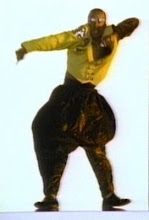
Good God where would we be without adjectives! Imagine if some of the greatest movies didn't have adjectives to emphasise their awesomeness? We would have action movies with names like 'Death that is going to happen now', 'More Than One Target' and 'Target that I keep missing'. As this would not do justice to the man that inspires all these movies, Jean-Claude Van Damme. Let's pay homage to him now.


Friday, 23 April 2010

All the single clauses!


If Beyonce Knowles was a piece of grammar, what would she be? I'll tell you.

But first, let's get retrospective for a moment. With MC Grammar, you have explored a lot of wonderful parts of grammar. Our minds have become so entwined that sometimes, when you're writing a letter, or trying to do a written test, or just throwing down some thoughts onto paper, you suddenly hear a voice that you imagine to be what MC Grammar would sound like; a deep, soothing voice, a bit like steel-capped boots dragging over gravel, that strokes the inside of your mind and gently whispers the correct grammatical form to you. 'Thank you, MC Grammar', you gently whisper. 'No thanks needed' you hear my voice whisper back.

But there has been a certain issue that we've been skirting around lately, and this is it: 'What are independent and dependant clauses, and why do they affect everything I do?'

Here's why.

A clause is a phrase. Sometimes it's a single sentence, but the rule is that it must contain two things: a subject and a predicate, or, the thing done or being done to the subject. Because this can be a bit confusing, here's very simple sentence to explain this.

The cat sat on the mat.

The thing being done (predicate) is 'sitting'. The thing (the subject) doing the sitting is the cat. Because the cat is the one 'doing' the verb, the cat is the subject. If it just so happened that it was the mat 'doing' the sitting on itself, then the mat would be the subject. But that would be pretty crazy.

Another example is:


Jo is writing a sentence.


What is being done? Writing. So it is the predicate. Who is 'doing' the predicate? Jo. So he/she is the subject.


'Whatever, MC Grammar!' you might scream out: 'In the same way I just know how to ride a bike, I just know how to write a sentence!' Sure, maybe, but when you don't know how a subject and a predicate go together, your whole meaning can get lost. Take for example this bomb site:

Clarise is the girl who is standing next to Lance, with the blond hair.

The problem here is that there are two subjects and one thing being done, AND there is an incomplete clause hanging onto them. The result is that you end up having no idea who has blond hair. A better way to say it would have been:

Clarise is the girl with blond hair, standing next to Lance.

Here, the subject and the predicate live together, cheerfully, in a relationship based on trust and mutual respect. Loitering by their side is the mousy but helpful, 'standing next to Lance', which can't stand on it's own, unlike 'Clarise is the girl with the blond hair', which doesn't need anybody when it's up in the club.

As you might have guessed by now, if Beyonce Knowles was a kind of grammar, she would be an independent clause. But which person best defines a dependant clause? There are many to pick from, but MC Grammar thinks Perez Hilton would be a good candidate. Relying on celebrities to be famous? Take a cue from Bouncy Knowles, Perez!