Search This Blog

Showing posts with label Romans. Show all posts

Tuesday, 3 April 2012

What is the difference between i.e. and e.g.?

The term i.e. tends to come up a lot in writing, but what does it actually mean? And why is it different from e.g?

I.e. is an abbreviation for the Latin term 'id est', which means 'that is' or 'in other words'. So you use i.e. when you want to clarify things a little bit further. For example:

The key issue at hand, i.e. who will rid of all this raw sewerage, really needs to be addressed as soon as possible.

Things got a lot worse after that, i.e everybody died.

E.g. on the other hand, is short for 'exampli gratia', which means 'for example'. As you can see, e.g. wouldn't work in the two examples we looked at above, because the i.e.'s in question are not examples of something, they are the key clarifying aspect of the sentence.

So if you want to say something like 'a number of vegetables, for example, carrots, celery, snow peas and beets, appear to have come to life', you could also say 'a number of vegetables, e.g. carrots, celery, snow peas and beets, appear to have come to life.'

or, A lot of the things that people need, e.g. clean water, shelter, and food, are inaccessible since the floods.

And what is the deal with the full stops that come out of nowhere?  Yes, as you might have noticed both i.e. and e.g. have awkward full stops after them. But the truth is, those full stops are there because both i.e. and e.g. are abbreviations.

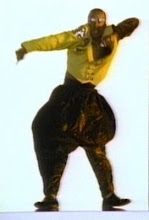
While we think about these differences, let's look at this picture of an actor playing Mark Antony, a famous Latin speaker, pictured here trying to decide who he's going to kill next.

Mmmm. Well, there are a number of people who might just stand in the way of me gaining absolute power, and there are a number of ways I could kill them, e.g. push them over a cliff, poison them, or even send an army to snuff them out.

Wednesday, 22 July 2009

U Can’t Split This: the old-school rule of not splitting your infinitives.

MC Grammar is from the school of thought that the purpose of grammar and punctuation is to communicate better with each other. It should make it easier to communicate with more people – not less. So when something can be understood without being technically grammatically correct, then I think it should become acceptable.

A good example of this is ‘Split Infinitives.’

An infinitive is the ‘stem’ of a verb. In other words, it is the universal form of the verb, when it hasn’t been changed. For example, ‘To have’, ‘to change’ ‘to eat’, etc. Verbs stop being infinitive when they are changed to fit with different tenses or to agree with plurals, for example, if 'to have' is the infinitive,‘We have lunch with Sam’ could become ‘We had lunch with Sam’ or ‘She has lunch with Sam.’ and so on.

About thirty years ago, school kids were being taught that an infinitive form of a verb could not be separated from its little ‘to’ companion. For example, saying ‘I need to quickly speak with you’ was regarded as bad grammar. The reason? In Latin, as in some other Latin-based languages today, an infinitive could never be split, not least because the ‘to’ part was built into it, in the same way as the French infinitive for ‘to speak’ is ‘Parler’, hence it couldn’t be split, obviously, unless you were some crazy person who thought it was cool to wedge a whole extra word into the centre of another.

So the key reason that you weren’t meant to split an infinitive was because some other language, one that people tended to look up to as being more distinguished, couldn’t split its own infinitives. This is why people in old novels tend to say things like ‘I need quickly to speak with you.’ Or ‘Finally I go to attend to mama today.’

Sticking to the rule of infinitives is all very well if you happen to go back in time, find yourself in Ancient Rome, can’t speak of word of Latin but feel reassured that whatever they’re saying, they’re not splitting their infinitives, but what relevance does it have for speakers of modern English? A sentence continues to make sense even where an infinitive has been split, and so as far as MC Grammar is concerned, pack this rule away next to your mini-disc player and your floppy discs.