Search This Blog

Thursday, 13 August 2009

The semi-colon: what has it done for you lately?

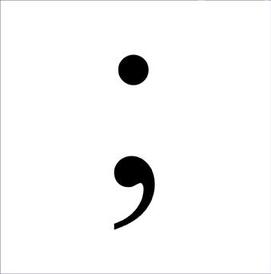
This is a semi-colon

http://futility.typepad.com/futility/images/semicolon.jpg

MC Grammar thinks that in our time, no piece of punctuation is more divisive. You might notice that I have just made an excellent pun.

Because of confusion about what this humble sign does exactly, people tend to avoid it, instead of risk using it and looking like a fool.

So what is a semi colon, and what does it do? Put simply, a semi-colon is a pause or break in a sentence. Its first use was to separate words or statements of opposed meaning in the same sentence.

For example:

They say hot dogs contain traces of arsenic; I say they contain traces of delicious.

Here, the statements are closely related but oppose each other, and the fact that they oppose each other wouldn't be as obvious if you used a full stop instead of a semi-colon.

A semi-colon is also used when you are listing items in a sentence.

For example:

He looked in the bag and made a mental note of everything that was inside; pears; plums; oranges; glasses.

As recently as fifty years ago, semi-colons were everywhere. Authors used them more than a little liberally, such as Virginia Woolf, who wrote 'To The Lighthouse.' She wrote sentences like this:

'She felt herself transfixed by the intensity of her perception; it was his severity; his goodness.'

You can see how Woolf is showing how the character's thoughts about the man are complex, but they still belong together, and we see this with the help of the semi-colon.

The semi-colon also imitates the way we speak. A comma shows where a person has stopped for breath, and a semi-colon does the same, with the addition of showing us where a change of mood is. When we read a book where someone is speaking and they do this,

It has come to the point where I can't go on with this charade anymore; but I will play along anyway.

We can see where the character has re-adjusted his or her thinking and mind-set. A comma can show where there has been a break, but it doesn't get across as effectively where the mind has repositioned itself.

In a way, the semi colon is like a thrust. It pulls back, pauses and then pushes forward again. It hesitates with a notion and then continues with it, realigning itself with a new, but linked idea. It does something no other form of punctuation can do, even the colon, which is like its slightly simple second cousin who shops at Chrisco , which I will talk about later. Colons I mean, not Chrisco. We won't talk about Chrisco here.

A lot of people find the semi-colon intimidating. Even with the above information, it can be hard to know when to use it. And a lot of people think that the semi-colon's days are numbered, and that soon it will be an outdated form of punctuation. American journalist James Kilpatrick even called it 'girly', just to throw in some random sexism as his contribution to the debate.

It's true that the semi-colon makes a sentence a little bit complicated. That's because it contains two thoughts, not one, and it makes the sentence longer, and on the whole, people don't like that. They want their sentences like they want their food. Quick and simple. No fiddly bits, nothing that they'll need to get a fork out for. But it can't always be pre-cooked mini-pies, sometimes it has to be cheese fondue and fiddly long cheese-prongs, and hot tea afterwards, so all the cheese doesn't harden in your stomach and kill you. And just like fondue, there's nothing quite like the semi-colon. So pull out your cheese prongs of punctuation and set up your mini gas-heater of expression, and let the punctuation do its job.

Monday, 10 August 2009

Please form an orderly queue for your good-grammar vaccination

MC Grammar recently received a series of vaccinations, and now feels ready to take on the world. Rabies, Hepatitis A and B can't hurt me, neither can Malaria, Diphtheria, Typhoid or Yellow Fever. It's a good feeling. Sorry all you anti-immunisation lobbyists, I'm immunised up to my eyeballs and I love it.

Some fun times were had over the last few weeks, as I regularly rocked up to my local surgery and chatted cheerfully away to my nurse, as she cleverly lulled my muscles into relaxed state, before jabbing a total of 9 needles into me. But an interesting point was raised during the many afternoons I spent there: are you immune to, or immune from, a disease?

Before we go further, this might be a good moment to brush up on our understanding of prepositions. A preposition is a 'linking' word, such as to, from, over, or during. What they link is nouns, phrases or pronouns to the sentence. They're like the MC that introduce the main act. For example,

The book is beside the table.

That said, what's the story with being immune to, or immune from? Well brothers and sisters, it's a complicated story, because it depends what you're talking about. If you are talking about being protected from an 'undesirable circumstance' such as getting criminally prosecuted, or heavily taxed, then you are immune from. For example, you can be 'immune from arrest', or 'immune from criticism.'

However, when you're talking about something you're not susceptible or responsive to, you use immune to. For example 'I am immune to Polio.'

This is a tricky mother. The Oxford English Dictionary gives lots of examples of 'immune to' and 'immune from' that don't follow the pattern above. Merriam-Webster's Collegiate Dictionary uses the 'immune to' phrasing to include anything a person might be resistant to, for example, 'he was immune to all pleas.' It's one of those things that if you think about it too hard, you can fry your brain and alienate yourself from your loved ones.

MC Grammar thinks that if you just surf the preposition wave, this one sort of sorts itself out. When you think about it, it makes sense that you're immune 'from' something that you're trying to get away from, or would rather not happen, and you're immune 'to' something that you have personally arranged will never happen. Take MC Grammar and Rabies, for example, I will never meet my end by frothing at the mouth – I've seen to that.

Sunday, 26 July 2009

MC Grammar gives props to those who deserve it

MC Grammar has learnt that Cleo Magazine in Australia has been giving some funky props to this blog on Twitter, helping MC Grammar bring grammar into the lives of even more brothers and sisters. Check it.

http://twitter.com/cleomag/status/1800188993

What can I say but ‘thanks!’ to Cleo for reading, and for spreading the word. Below are some of the many ways I would say thanks to Cleo if I only could say it in person

Wednesday, 22 July 2009

U Can’t Split This: the old-school rule of not splitting your infinitives.

MC Grammar is from the school of thought that the purpose of grammar and punctuation is to communicate better with each other. It should make it easier to communicate with more people – not less. So when something can be understood without being technically grammatically correct, then I think it should become acceptable.

A good example of this is ‘Split Infinitives.’

An infinitive is the ‘stem’ of a verb. In other words, it is the universal form of the verb, when it hasn’t been changed. For example, ‘To have’, ‘to change’ ‘to eat’, etc. Verbs stop being infinitive when they are changed to fit with different tenses or to agree with plurals, for example, if 'to have' is the infinitive,‘We have lunch with Sam’ could become ‘We had lunch with Sam’ or ‘She has lunch with Sam.’ and so on.

About thirty years ago, school kids were being taught that an infinitive form of a verb could not be separated from its little ‘to’ companion. For example, saying ‘I need to quickly speak with you’ was regarded as bad grammar. The reason? In Latin, as in some other Latin-based languages today, an infinitive could never be split, not least because the ‘to’ part was built into it, in the same way as the French infinitive for ‘to speak’ is ‘Parler’, hence it couldn’t be split, obviously, unless you were some crazy person who thought it was cool to wedge a whole extra word into the centre of another.

So the key reason that you weren’t meant to split an infinitive was because some other language, one that people tended to look up to as being more distinguished, couldn’t split its own infinitives. This is why people in old novels tend to say things like ‘I need quickly to speak with you.’ Or ‘Finally I go to attend to mama today.’

Sticking to the rule of infinitives is all very well if you happen to go back in time, find yourself in Ancient Rome, can’t speak of word of Latin but feel reassured that whatever they’re saying, they’re not splitting their infinitives, but what relevance does it have for speakers of modern English? A sentence continues to make sense even where an infinitive has been split, and so as far as MC Grammar is concerned, pack this rule away next to your mini-disc player and your floppy discs.

Saturday, 4 July 2009

More correct than you: How hypercorrections impress no-one.

I once heard a great quote that went ‘a high brow is just someone who has been educated beyond their intelligence.’ There’s a lot of truth in there. The great institution of grammar tends to be a haven for people who know a lot about language, but not much about anything else, such as not being jerks.

This is where the scourge of ‘hypercorrections’ hits us. A hypercorrection is where a non-standard grammatical rule is applied in the belief that it is correct, even though a more familiar, standard rule would work just fine. Put simply, it’s masturbation with words.

One of the most common hypercorrections is the Me and I rule. Most people are taught at school that you don’t say ‘Me and you should eat our lunches now’, you say, you and I should eat our lunches now. That’s fine, but I don’t know about you, but as a kid at school, MC Grammar had it drummed into his head that using the word me was as bad as stripping naked and doing a poo on the Queen of Sweden, due to the idea that it could be uncouthly misused where the more refined I should have been.

As a result, a lot of people tend to think that using I is more proper than using me. This is where you get sentences like 'He gave it to you and I'. This is incorrect. The rule is that the pronoun (You, we, she, he, them) that would stand in isolation is the one that you should use. For example, you would say I went to the movies, therefore you would say You and I went to the movies. However, you would say he gave it to me, not he gave it to I, therefore you would say he gave it to you and me, not he gave it to you and I.

The best way to remember this rule is to simply remind yourself that the pronoun that would stand in isolation is the one to use. For example, when you hear someone say The letter was for you and I, you know that they should have said The letter was for you and me, because you can't say The letter was for I (Unless you are a seventeenth-century fictional pirate, obviously)

This cool video which talks about the correct pronounciation of often, might be just what you need to help you along as you let your thoughts about hypercorrection sink in. Enjoy!


Thursday, 18 June 2009

Feeling Sarcastic? Try some capital letters!

So, MC Grammar has become an exam invigilator. This means that I let kids into exams, then I give them their exam papers and I tell them all the important rules about the exam. Then if anything goes wrong, like a paper with a messed-up question, or a freak-out by one of the kids, MC Grammar is right on top of it, sorting it out, talking them off the roof, returning them to their table, and making a note of all incidents in the special invigilator file.

But just the other day, I noticed something alarming. I was reading my special invigilator handbook, accurately titled General, Vocational and Diploma Qualifications – Instructions for conducting examinations. It struck me as a bit strange that since this was the title of the handbook, they hadn’t followed the general rule of capitalising all the key words, and left ‘conducting’ and ‘examinations’ alone to fend for themselves against a whole crowd of fearsome capitalisations.

But it got worse. Down the bottom of the page read ‘At least one copy of these Instructions must be available in each examination room.’

Why did ‘Instructions’ get a capital letter? Yes, it’s a noun, i.e it is the name of something, and technically the names of things get capitalised, but ‘copy’, ‘examination’ and ‘room’ are all nouns too, aren't they? Where was their glory? Where was their time to shine?

There are some basic rules for capitalising words. Let’s power through the basic ones first, then jump into the big daddies afterwards.

A word needs to start with a capital letter when it is:

1. A day of the week. Take note that the seasons are not capitalised.

It was Wednesday by the time I realised that it was autumn.

2. The name of a language.

Apparently Hungarian is really hard to learn.

Complication alert! The names of subjects in school are not capitalised, unless they happen to be languages.

Today I have geography, maths and Spanish.


3. The first word of a sentence, or comes after an exclamation or question mark.

Have we seen the last of Janet Jackson’s left nipple? Probably not.

The names of festivals, holidays and holy days

Such as Christmas, Ramadan, the feast of Purim and Halloween.

4. Distinctive historical periods

London was a prosperous city during the Middle Ages.

Britain was the first country to experience the Industrial Revolution.
The Greeks were in Greece during the Bronze Age

4. The first word of a direct quotation

In my frustration I cried out ‘It has come to this and I blame myself!’ A passer-by wearing a Trent from Punchy shirt comforted me.

BUT there is no capital if the quotation is not a complete sentence.

The mayor described the stealing of his trousers as 'disappointing'

OK, so that’s all fairly straight forward. The next set of rules flirt a little more with the grey area between ‘nouns that get all the glory’ and ‘nouns that nobody loves’.

Words need to start with a capital for:

5. Proper names. A proper name means a name or title that refers to a person, a place, and institution or an individual event.


My name is Tom Baker

There was a fight between Professor Lacey and Doctor Davis

The Golden Gate Bridge is in San Francisco Bay

The Queen is addressing the House of Commons

I’m trying out for the Winter Olympics


This can get mighty confusing. For example:

I have met the President.

Dave is the president of a massive company.

In the first sentence, ‘President’ is capitalised because it refers to a specific person. In the second, ‘president’ is just the description of Dave’s job. Here’s another example.

Saint Servatius is the patron saint of rats.

‘Saint Servatius’ is the title and name of Saint Servatius, but ‘patron saint’ is not, and so gets no capital.

The title of a book, play, poem, film magazine, etc. Basically if it’s the title of a piece of art, media or entertainment, it gets capitalised. Note that words like 'the', ‘of’, ‘and’ or ‘in’ are not capitalised unless it’s the first word.

That movie 'Bully' is messed up.

Just because I haven’t read 'The Tenant of Wildfell Hall' doesn’t mean I can’t guess what happens in the end.

I enjoy the classical piece, 'Air on the G String'.


Aunt May keeps telling me how losing my virginity will be like giving away a Special Flower.

According to Ben, Fallout Boy are the Next Big Thing.


Can’t you just hear the sarcasm dripping off the page! If you ever want to own someone using the power of grammar, this is all you need to know.

So suddenly, I think I have the answer to why ‘Instructions’ is such a special word, while all the sad little words around it get ignored. ‘Instructions’, unlike ‘copy’, ‘examination’ and ‘room’, not only refers to a specific thing, unlike, say ‘room’, which could refer to any which room the instructions find themselves in, but it’s also the official, or ‘proper’ title of the thing which MC Grammar finds himself holding in his hand.

And so another grammar mystery has been solved!
MC Grammar’s personal favourite use of capitalisations is to indicate sarcasm. You might have noticed that sarcasm is generally limited to spoken word, because it mostly gets expressed through tone of voice. For example, if I was to write that I really enjoy the films of Kevin Costner, you can’t be sure if I’m being sarcastic or if I’m an idiot without hearing the tone of my voice.

Wednesday, 3 June 2009

Many funky uses of the apostrophe


Like a lover you come to know expertly over time, we have now come to know the apostrophe intimately. We have seen it from many different angles and in many different lights. We’ve looked at the rule of Its and It’s, and the rule of indicating possessives, but there are still a few uses of the apostrophe that we haven’t explored.

But first, let’s get reacquainted with some old friends. In 2002, the Australian show Popstars manufactured a pop group called Scandal’us. Here they are, touching each other in a suggestive way. A year earlier, the UK version of the same show produced a band called Hear’Say.

Band names like this say a lot about how little we understand apostrophes. The apostrophe has a group of vital functions in grammar and language. If it was a person, it would be the head of a laboratory that was researching climate change, or an award- winning journalist who had been reporting on government corruption. It would be an important person, but a very serious one. It definitely would not be happy to be thrown into a dodgy pop group’s name by their manager as some sort of pretend rebellion against society.

MC Grammar believes that it’s no coincidence that both these bands had disrespect for the apostrophe, and that they both broke up within a year of winning the Popstars competition. Sadly, at least one of these people now sleeps with Kyle Sandilands, and MC Grammar thinks that in a way, that’s also karmic retribution for mistreating the apostrophe. Don’t let that happen to you. Follow the simple rules for using apostrophes.

1. It indicates time or quantity.

In one week’s time

Or, if the amount of time or quantity is plural:

Two weeks’ notice


Four metres’ worth of rope


2. It indicates the omission if figures in dates

It was the summer of ‘69

3. It indicates the omission of letters

I come from Jo’burg.


I hadn’t thought of that.

She should’ve thrown this out.


Where is the cat-o’-nine-tails?

Bear in mind that there are lots of words that are shortenings of other words, but have become so common in their own right that it’s not necessary to use an apostrophe to indicate the part that’s been left off. For example, phone is a shortening of telephone, and fridge is a shortening of refrigerator, but this is an example where the punctuation isn’t needed because the meaning doesn’t get lost without it.

4. It features in Irish names such as O’Reilly and O’Malley.

5. It indicates the plurals of letters,

Such as: How many t’s are there in attachment?


The apostrophe can also be sometimes be used to indicated non-standard English, like in ‘Lady Chatterley’s Lover’ when the gamekeeper speaks vernacular English, while Lady Chatterley doesn’t. For example, he says,

If yer want ter be ‘ere, yo’ll non want me messin’ abaht a’ th’ time

But this isn’t a hard and fast rule. Just do what your heart tells you.