Search This Blog

Showing posts with label Colons. Show all posts

Wednesday, 14 March 2012

Mission: To pause for half a second.

At the end of last year, the fourth Mission: Impossible film came out.

I remember seeing the first Mission: Impossible film. I was just a slip of a thing, and me and my friends had a sleep over and watched it. But no matter how hard I tried, I had no fucking idea what was going on. As far as I could tell, some people the main guy cared about were killed, and he somehow knew who was to blame, so he packed a bag, made some phone calls from the airport, and killed everybody. There was a very confusing sequence where he abseiled from the roof in order to steal something, but really, that's all I could work out.

Four years later, the second Mission: Impossible film came out, and I went to the movies on a date. Again, this move seemed to make absolutely no sense. It had something to do with a vial of disease, a woman who was good at driving a car, and Tom Cruise also enjoyed abseiling in that film too, but mostly just for leisure in the same way that some people enjoy taking a nap in the middle of the day, or having a kit kat in the middle of the afternoon.

When the third film came out, and I found out about it, I exclaimed loudly: 'no fucking way am I going to see that movie. The last two didn't make sense, and I've got too much on my plate, and no one on God's green earth can trick me into seeing it.'

And I was right. Now, with the fourth film on it's way, I still feel happy with my realisation that the Mission: Impossible films make absolutely no sense.

But there is one thing about the Mission: Impossible films that keeps me awake at night, and that it the mysterious colon that lives between the words 'mission' and 'impossible'.

The colon looks like this


Although it resembles the semi-colon, the colon is used for telling the reader that what follows in a sentence will prove, clarify, explain, or simply list items in relation to what is referred to before.

The verdict was in: The jury took their places with resolved faces.

There could be no mistaking it: It was the same gnome she had thrown out the week before.

She checked the contents of her bag again: Lipstick, banana, diary, passport, pick axe, chestnuts and bleach.

Another useful way to think of the colon is to regard it as a brief pause  it's a little longer than a comma or a dash, and can be used to lend importance to what is about to follow it.

So, considering all this, having a colon in the middle of 'mission' and 'impossible' is like saying 'this mission is totally impossible'. The 'impossible' part is the clarifying part, explaining exactly what short of mission we're dealing with here. A damn impossible one.


'Lucky no-one put a CCTV camera in here, or this would look totally stupid.'

Thursday, 13 August 2009

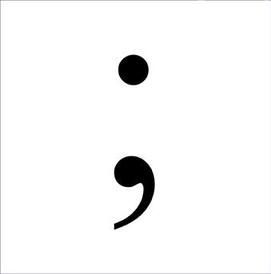
The semi-colon: what has it done for you lately?

This is a semi-colon

http://futility.typepad.com/futility/images/semicolon.jpg

MC Grammar thinks that in our time, no piece of punctuation is more divisive. You might notice that I have just made an excellent pun.

Because of confusion about what this humble sign does exactly, people tend to avoid it, instead of risk using it and looking like a fool.

So what is a semi colon, and what does it do? Put simply, a semi-colon is a pause or break in a sentence. Its first use was to separate words or statements of opposed meaning in the same sentence.

For example:

They say hot dogs contain traces of arsenic; I say they contain traces of delicious.

Here, the statements are closely related but oppose each other, and the fact that they oppose each other wouldn't be as obvious if you used a full stop instead of a semi-colon.

A semi-colon is also used when you are listing items in a sentence.

For example:

He looked in the bag and made a mental note of everything that was inside; pears; plums; oranges; glasses.

As recently as fifty years ago, semi-colons were everywhere. Authors used them more than a little liberally, such as Virginia Woolf, who wrote 'To The Lighthouse.' She wrote sentences like this:

'She felt herself transfixed by the intensity of her perception; it was his severity; his goodness.'

You can see how Woolf is showing how the character's thoughts about the man are complex, but they still belong together, and we see this with the help of the semi-colon.

The semi-colon also imitates the way we speak. A comma shows where a person has stopped for breath, and a semi-colon does the same, with the addition of showing us where a change of mood is. When we read a book where someone is speaking and they do this,

It has come to the point where I can't go on with this charade anymore; but I will play along anyway.

We can see where the character has re-adjusted his or her thinking and mind-set. A comma can show where there has been a break, but it doesn't get across as effectively where the mind has repositioned itself.

In a way, the semi colon is like a thrust. It pulls back, pauses and then pushes forward again. It hesitates with a notion and then continues with it, realigning itself with a new, but linked idea. It does something no other form of punctuation can do, even the colon, which is like its slightly simple second cousin who shops at Chrisco , which I will talk about later. Colons I mean, not Chrisco. We won't talk about Chrisco here.

A lot of people find the semi-colon intimidating. Even with the above information, it can be hard to know when to use it. And a lot of people think that the semi-colon's days are numbered, and that soon it will be an outdated form of punctuation. American journalist James Kilpatrick even called it 'girly', just to throw in some random sexism as his contribution to the debate.

It's true that the semi-colon makes a sentence a little bit complicated. That's because it contains two thoughts, not one, and it makes the sentence longer, and on the whole, people don't like that. They want their sentences like they want their food. Quick and simple. No fiddly bits, nothing that they'll need to get a fork out for. But it can't always be pre-cooked mini-pies, sometimes it has to be cheese fondue and fiddly long cheese-prongs, and hot tea afterwards, so all the cheese doesn't harden in your stomach and kill you. And just like fondue, there's nothing quite like the semi-colon. So pull out your cheese prongs of punctuation and set up your mini gas-heater of expression, and let the punctuation do its job.