BREAKING GRAMMAR NEWS: Reading University (UK) researchers revealed that they have identified the oldest English words, which are tens of thousands of years old.
To do this, they had to what always has to be done in situations such as these: they built a super computer.
Most of the languages from Europe to Asia fall under the category of Indo-European languages, and the vocal sounds they use to express a certain concept are very similar. This means that when new words arise, you can spot them because they don't sound similar. So using their super computer, the boffins at Reading University could work out the age of a word.
'You type in a date in the past or in the future and it will give you a list of words that would have changed going back in time or will change going into the future,' Mark Pagel, an evolutionary biologist at the University of Reading told BBC News.
'From that list you can derive a phrasebook of words you could use if you tried to show up and talk to, for example, William the Conqueror.'
The words they found that had been around for the longest were I, we, two and three. MC Grammar can't be sure why two and three were so popular back then – maybe things only came in sets of two and three – we will never know.
They could also predict what words will be going out of style very soon. They were squeeze, guts, stick and bad as probable first casualties.
'We use a computer to fit a range of models that tell us how rapidly these words evolve,and we can estimate the rates at which these things are replaced through time'.
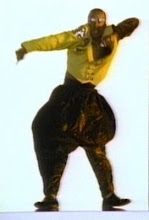
And now, to tip our grammar hats to these dying words, we can do no better than to celebrate one of them by looking back at the glorious hey day of the word bad, with a cameo by Michael Jackson.
Showing posts with label Old English. Show all posts
Showing posts with label Old English. Show all posts
Tuesday, 3 May 2011

Wednesday, 26 January 2011
Dr Whom and the attack of the archaic language
Try to get your head around this: scientists believe that there was a time when neanderthals and modern humans existed at the same time. Here's a picture comparing a modern human and a neanderthal.

But the neanderthals ended up dying out for some reason. We can't be sure what happened to them (although some evidence suggests that we ate them) but what we can be sure of is that the period of co-existence must have been a pretty crazy time for neanderthals and modern humans alike. They probably spent their whole day just staring at each other, thinking 'wow, you're sort of like me, but at the same time, you're not' Maybe modern humans just ended up eating the neanderthals just to deal with the craziness of the situation.
But what you don't even realise, grammar brothers and sisters, is that we are living in just as crazy a time right now, with the co-existence of the words who and whom.
As you might know, some of us have the idea that 'whom' is the more correct version of who. This is not true. Whom and who have different functions, and back in their glorious heyday they lived side by side, two versions of the same species.
Traditionally, whom was used if you were referring to the object of a sentence, for example:
He is the one to whom I owe my life.
If you are referring to the subject of a dependant or a ('subordinate') clause then you would use 'who'
He's just a great guy who cares about safety around the home.
But stop right there. Before you log off your computer and run out into the streets, throwing out 'whom' in everything you say without a care for who can hear you, let me explain something. For a long time, the use of 'whom' has been getting used less and less, making it archaic. This means that it has fallen out of use so much that it's no longer the right way to say something, and in most cases where you would have said 'whom' fifty years ago, it is now correct to say 'who'.
You might respond to this in horror, you might say, 'but just because people don't know how to use grammar properly doesn't mean that we should just lay down and die like dogs'. But the thing is, language changes all the time. In old English, spoken 1000 years ago, the word for 'who' was 'hwa'. Imagine how pissed off people back then must have been when all those uneducated punks, with their ridiculously long trendy cloth shoes, started saying who instead? If microsoft word had existed back then, it would have immediately flagged who as a misspelling, but after people had been saying it for a few years, everyone just gave up and started saying who instead.
And the same goes for whom. In 1989, the Oxford English Dictionary printed for the first time that whom was 'no longer current in natural colloquial speech', and they were right. In most cases, who is now used. You can still use whom in the traditional way, but if you do, you will no longer be speaking what is known as 'plain' English or 'colloquial' English. You'll be speaking using archaic words out of context, and that's just as incorrect as using the wrong grammar or the wrong tense, so what's the point of that?
There is, however, one use of whom that is still alive and kicking is when it comes after a preposition in more formal language. For example:
To whom it may concern
To whom have you been speaking?
With whom will we be coming to the meeting?
Of course, in these cases, you could always say something like 'who have you been speaking with?' or 'who will we be coming to the meeting with?' and it would be just as correct. That's the beauty of language – there's more than one way of doing things.
So what did happen to our neanderthal brothers and sisters? Well, there's not a lot of scientific evidence to back me up, but I like to think that neanderthals and modern humans put aside their differences and their animal skins and just got freaky with each other, leading their DNA to be incorporated into ours. But there are other dreamers like me – enjoy this montage from the movie 'Clan of the Cave Bear', where an early modern human is adopted and lives with neanderthals.

But the neanderthals ended up dying out for some reason. We can't be sure what happened to them (although some evidence suggests that we ate them) but what we can be sure of is that the period of co-existence must have been a pretty crazy time for neanderthals and modern humans alike. They probably spent their whole day just staring at each other, thinking 'wow, you're sort of like me, but at the same time, you're not' Maybe modern humans just ended up eating the neanderthals just to deal with the craziness of the situation.
But what you don't even realise, grammar brothers and sisters, is that we are living in just as crazy a time right now, with the co-existence of the words who and whom.
As you might know, some of us have the idea that 'whom' is the more correct version of who. This is not true. Whom and who have different functions, and back in their glorious heyday they lived side by side, two versions of the same species.
Traditionally, whom was used if you were referring to the object of a sentence, for example:
He is the one to whom I owe my life.
If you are referring to the subject of a dependant or a ('subordinate') clause then you would use 'who'
He's just a great guy who cares about safety around the home.
But stop right there. Before you log off your computer and run out into the streets, throwing out 'whom' in everything you say without a care for who can hear you, let me explain something. For a long time, the use of 'whom' has been getting used less and less, making it archaic. This means that it has fallen out of use so much that it's no longer the right way to say something, and in most cases where you would have said 'whom' fifty years ago, it is now correct to say 'who'.
You might respond to this in horror, you might say, 'but just because people don't know how to use grammar properly doesn't mean that we should just lay down and die like dogs'. But the thing is, language changes all the time. In old English, spoken 1000 years ago, the word for 'who' was 'hwa'. Imagine how pissed off people back then must have been when all those uneducated punks, with their ridiculously long trendy cloth shoes, started saying who instead? If microsoft word had existed back then, it would have immediately flagged who as a misspelling, but after people had been saying it for a few years, everyone just gave up and started saying who instead.
And the same goes for whom. In 1989, the Oxford English Dictionary printed for the first time that whom was 'no longer current in natural colloquial speech', and they were right. In most cases, who is now used. You can still use whom in the traditional way, but if you do, you will no longer be speaking what is known as 'plain' English or 'colloquial' English. You'll be speaking using archaic words out of context, and that's just as incorrect as using the wrong grammar or the wrong tense, so what's the point of that?
There is, however, one use of whom that is still alive and kicking is when it comes after a preposition in more formal language. For example:
To whom it may concern
To whom have you been speaking?
With whom will we be coming to the meeting?
Of course, in these cases, you could always say something like 'who have you been speaking with?' or 'who will we be coming to the meeting with?' and it would be just as correct. That's the beauty of language – there's more than one way of doing things.
So what did happen to our neanderthal brothers and sisters? Well, there's not a lot of scientific evidence to back me up, but I like to think that neanderthals and modern humans put aside their differences and their animal skins and just got freaky with each other, leading their DNA to be incorporated into ours. But there are other dreamers like me – enjoy this montage from the movie 'Clan of the Cave Bear', where an early modern human is adopted and lives with neanderthals.
Subscribe to:
Posts (Atom)