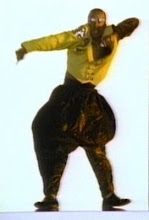
Have you ever noticed that sometimes people say things like 'If I were able to, I would dance all night', or 'If I were president, I'd make it illegal to chew loudly', and you're all like 'hang on friend, why are you talking in the past tense? Don't you mean "If I was able to, I would dance all night", and "If I was President, I'd make it illegal to chew loudly"?'
And then they say 'no way! I mean "if I were able to", because I'm talking in the subjunctive.'
The subjunctive is a verb form that you use when you are talking about scenarios that are not definitely going to happen.
For example, instead of saying 'If I was God', you would generally say 'If I were God', because you're probably not going to become God anytime soon.
The structure of the subjunctive is easy. For all verbs except the past tense of be, the subjunctive is the same as the bare infinitive (infinitive without "to"):
be (past) be (present) Other verbs, (i.e to swim)
I were I be I swim
you were you be you swim
he, she, it were he, she, it be he, she, it swim
we were we be we swim
you were you be you swim
they were they be they swim
As you can see, the subjunctive does not change according to person (I, you, he etc).
Here are some examples with a subjunctive verb:
The farmer insists that the barn be locked at night.
The doctor recommended that he join a gym.
It is essential that we leave as soon as possible
It was necessary that every student submit an essay by Friday
And now, a subjunctive treat for all my grammar brothers and sisters, an amazing home made video by two very clever cats, all about the Spanish subjunctive. It's a bit off topic for us, since I usually talk about Spanish grammar on my other blog 'Señor Gramática - Basta!, Es el momento de la gramática!' but who can resist when these two bright students sing 'And I'm like, Present, Present Subjunctive'
Tuesday, 29 March 2011

Friday, 18 March 2011
Who's laughing now? The difference between whose and who's
A while ago MC Grammar got addicted to wiki answers. It's hard to say what it was about this particular interactive social media that I fell for: perhaps it was the satisfying aspect of asking a question, then an anonymous person taking the time to read over my question, then answer it seriously. After a few months, wiki answers was being taken over more and more by people who didn't believe in dinosaurs, so I just lost interest and took up nature photography instead. But back when I was having good times on wiki answers, sometimes I liked to mix it up a little bit and ask unusual questions. Once, during a late night session on wiki answers, I asked Whose hands are these? It didn't really mean anything, I just asked because it thought it might get an interesting answer. And an interesting answer it did receive, as the response I received back was: These are the hands of Banquo. Thank you, anonymous poster, I enjoyed this answer and its fun approach. I would like to see more of these on the internet.
And this brings us to our post for today, the difference between whose and who. The difference between these two words is a little bit like the difference between your and you're. They sound similar, but they mean very different things.
Always remember that:
Who's = 'who is'
Who's at the door?
Whose = possessive
Whose socks are these?
With the knowledge and understanding of these two words added to the stainless steel toolbox of your grammar skills, you will be able to construct the ultimate spice rack of grammar.
And this brings us to our post for today, the difference between whose and who. The difference between these two words is a little bit like the difference between your and you're. They sound similar, but they mean very different things.
Always remember that:
Who's = 'who is'
Who's at the door?
Whose = possessive
Whose socks are these?
With the knowledge and understanding of these two words added to the stainless steel toolbox of your grammar skills, you will be able to construct the ultimate spice rack of grammar.
Monday, 28 February 2011
'Commadore Norrington, my effects please': The difference between affect and effect
The difference between affect and effect has confused more than a few people. And make no mistake, sometimes even MC Grammar can end up throwing himself on his four-poster bed, howling in frustration at this very tricky area of grammar.
But lucky for us, the difference between affect and effect is a lot simpler than you might think. The thing is, effect and affect are homonyms, which means that even though they sound the same, they have different meanings. Read on, grammar children.
Affect means:
1. To have an influence or cause a change in something
Too much sunlight affected the quality of the photograph
2. To act on the emotions of, to touch, to move.
The arguments and fighting affected me badly
3. To attack or infect
Rabies affects the brain
Effect, on the other hand, means:
1. A result
The drugs took effect immediately
There was more positive information available about immigration, effecting a change attitudes towards immigrants.
2. The power to produce an outcome or achieve a result
The president's threats to kill everyone had no effect on the protesters
3. Something that produces a specific impression, or supports a general design or intention:
The fireworks were the best effects of the concert
If you ever get lost, there's a handy way of remembering the difference. In the movie 'Pirates of the Caribbean', Captain Jack Sparrow has managed to get off from being arrested. Demanding his stuff back, he says: 'Commodore Norrington, my effects please, and my hat'. When Sparrow asks for his effects he means his sword, his compass, and his belt. These are his effects, meaning the things that make him Captain Jack Sparrow. Your effects are the things that add a little something to the occasion, which is why fireworks are effects, or special animation techniques in a movie are effects.

But lucky for us, the difference between affect and effect is a lot simpler than you might think. The thing is, effect and affect are homonyms, which means that even though they sound the same, they have different meanings. Read on, grammar children.
Affect means:
1. To have an influence or cause a change in something
Too much sunlight affected the quality of the photograph
2. To act on the emotions of, to touch, to move.
The arguments and fighting affected me badly
3. To attack or infect
Rabies affects the brain
Effect, on the other hand, means:
1. A result
The drugs took effect immediately
There was more positive information available about immigration, effecting a change attitudes towards immigrants.
2. The power to produce an outcome or achieve a result
The president's threats to kill everyone had no effect on the protesters
3. Something that produces a specific impression, or supports a general design or intention:
The fireworks were the best effects of the concert
If you ever get lost, there's a handy way of remembering the difference. In the movie 'Pirates of the Caribbean', Captain Jack Sparrow has managed to get off from being arrested. Demanding his stuff back, he says: 'Commodore Norrington, my effects please, and my hat'. When Sparrow asks for his effects he means his sword, his compass, and his belt. These are his effects, meaning the things that make him Captain Jack Sparrow. Your effects are the things that add a little something to the occasion, which is why fireworks are effects, or special animation techniques in a movie are effects.

Saturday, 12 February 2011
Everything's not going to be alright
From a fan:
Dear MC Grammar. What's your position on owning and keeping firearms in the home?
Dear fan,
Firstly, thanks for writing. And thanks for asking this important question. What is my position on firearms in the home? Well, it shouldn't come as a surprise to anyone that I am very pro-firearms. I believe that every home should have two or three fully-loaded firearms, and that these should be placed within reaching distance of your bed, or wherever you sleep at night. If you have a habit of going to the bathroom during the night, and your bathroom is not close to where you sleep, such as in the case where you don't have a walk-in wardrobe, you should also keep a gun under your bathroom sink, or hanging from a shower curtain.
But the thing about this is that these firearms should only be for one specific purpose – to fight off incorrectly used words.
That's right, even in your own home, late at night when you are just relaxing with your loved ones, among your own hard-earned possessions, words that are not actually words can suddenly be breaking through your front window, traumatising your children and making love to your wife. What are you going to do when that happens? Are you going to just sit there and let the scene burn into your retinas? Or are you going to pull out your weapon and defend your loved ones like a warrior!?
Of course, by 'weapon', I mean your knowlege of grammar, and by 'firearm', I mean your astute oneness with language. And nowhere are these devices self-defense needed more than in the case of the confusion surrounding the words alright and all right.
A lot of people are confused about what the difference is between alright and all right. Luckily, this is a pretty easy problem to sort out, because alright is not a real word, in the same vein that 'alot' is not a word.
The best thing to do here is to remember this saying that Bill Walsh penned in his book, 'Lapsing into a Comma': 'alright is not all right'
Snap, Bill Walsh.
And don't forget, grammar children, always keep your weapons of grammar-knowledge loaded, and in an easy-to-reach place around the house.

Dear MC Grammar. What's your position on owning and keeping firearms in the home?
Dear fan,
Firstly, thanks for writing. And thanks for asking this important question. What is my position on firearms in the home? Well, it shouldn't come as a surprise to anyone that I am very pro-firearms. I believe that every home should have two or three fully-loaded firearms, and that these should be placed within reaching distance of your bed, or wherever you sleep at night. If you have a habit of going to the bathroom during the night, and your bathroom is not close to where you sleep, such as in the case where you don't have a walk-in wardrobe, you should also keep a gun under your bathroom sink, or hanging from a shower curtain.
But the thing about this is that these firearms should only be for one specific purpose – to fight off incorrectly used words.
That's right, even in your own home, late at night when you are just relaxing with your loved ones, among your own hard-earned possessions, words that are not actually words can suddenly be breaking through your front window, traumatising your children and making love to your wife. What are you going to do when that happens? Are you going to just sit there and let the scene burn into your retinas? Or are you going to pull out your weapon and defend your loved ones like a warrior!?
Of course, by 'weapon', I mean your knowlege of grammar, and by 'firearm', I mean your astute oneness with language. And nowhere are these devices self-defense needed more than in the case of the confusion surrounding the words alright and all right.
A lot of people are confused about what the difference is between alright and all right. Luckily, this is a pretty easy problem to sort out, because alright is not a real word, in the same vein that 'alot' is not a word.
The best thing to do here is to remember this saying that Bill Walsh penned in his book, 'Lapsing into a Comma': 'alright is not all right'
Snap, Bill Walsh.
And don't forget, grammar children, always keep your weapons of grammar-knowledge loaded, and in an easy-to-reach place around the house.

Wednesday, 26 January 2011
Dr Whom and the attack of the archaic language
Try to get your head around this: scientists believe that there was a time when neanderthals and modern humans existed at the same time. Here's a picture comparing a modern human and a neanderthal.

But the neanderthals ended up dying out for some reason. We can't be sure what happened to them (although some evidence suggests that we ate them) but what we can be sure of is that the period of co-existence must have been a pretty crazy time for neanderthals and modern humans alike. They probably spent their whole day just staring at each other, thinking 'wow, you're sort of like me, but at the same time, you're not' Maybe modern humans just ended up eating the neanderthals just to deal with the craziness of the situation.
But what you don't even realise, grammar brothers and sisters, is that we are living in just as crazy a time right now, with the co-existence of the words who and whom.
As you might know, some of us have the idea that 'whom' is the more correct version of who. This is not true. Whom and who have different functions, and back in their glorious heyday they lived side by side, two versions of the same species.
Traditionally, whom was used if you were referring to the object of a sentence, for example:
He is the one to whom I owe my life.
If you are referring to the subject of a dependant or a ('subordinate') clause then you would use 'who'
He's just a great guy who cares about safety around the home.
But stop right there. Before you log off your computer and run out into the streets, throwing out 'whom' in everything you say without a care for who can hear you, let me explain something. For a long time, the use of 'whom' has been getting used less and less, making it archaic. This means that it has fallen out of use so much that it's no longer the right way to say something, and in most cases where you would have said 'whom' fifty years ago, it is now correct to say 'who'.
You might respond to this in horror, you might say, 'but just because people don't know how to use grammar properly doesn't mean that we should just lay down and die like dogs'. But the thing is, language changes all the time. In old English, spoken 1000 years ago, the word for 'who' was 'hwa'. Imagine how pissed off people back then must have been when all those uneducated punks, with their ridiculously long trendy cloth shoes, started saying who instead? If microsoft word had existed back then, it would have immediately flagged who as a misspelling, but after people had been saying it for a few years, everyone just gave up and started saying who instead.
And the same goes for whom. In 1989, the Oxford English Dictionary printed for the first time that whom was 'no longer current in natural colloquial speech', and they were right. In most cases, who is now used. You can still use whom in the traditional way, but if you do, you will no longer be speaking what is known as 'plain' English or 'colloquial' English. You'll be speaking using archaic words out of context, and that's just as incorrect as using the wrong grammar or the wrong tense, so what's the point of that?
There is, however, one use of whom that is still alive and kicking is when it comes after a preposition in more formal language. For example:
To whom it may concern
To whom have you been speaking?
With whom will we be coming to the meeting?
Of course, in these cases, you could always say something like 'who have you been speaking with?' or 'who will we be coming to the meeting with?' and it would be just as correct. That's the beauty of language – there's more than one way of doing things.
So what did happen to our neanderthal brothers and sisters? Well, there's not a lot of scientific evidence to back me up, but I like to think that neanderthals and modern humans put aside their differences and their animal skins and just got freaky with each other, leading their DNA to be incorporated into ours. But there are other dreamers like me – enjoy this montage from the movie 'Clan of the Cave Bear', where an early modern human is adopted and lives with neanderthals.

But the neanderthals ended up dying out for some reason. We can't be sure what happened to them (although some evidence suggests that we ate them) but what we can be sure of is that the period of co-existence must have been a pretty crazy time for neanderthals and modern humans alike. They probably spent their whole day just staring at each other, thinking 'wow, you're sort of like me, but at the same time, you're not' Maybe modern humans just ended up eating the neanderthals just to deal with the craziness of the situation.
But what you don't even realise, grammar brothers and sisters, is that we are living in just as crazy a time right now, with the co-existence of the words who and whom.
As you might know, some of us have the idea that 'whom' is the more correct version of who. This is not true. Whom and who have different functions, and back in their glorious heyday they lived side by side, two versions of the same species.
Traditionally, whom was used if you were referring to the object of a sentence, for example:
He is the one to whom I owe my life.
If you are referring to the subject of a dependant or a ('subordinate') clause then you would use 'who'
He's just a great guy who cares about safety around the home.
But stop right there. Before you log off your computer and run out into the streets, throwing out 'whom' in everything you say without a care for who can hear you, let me explain something. For a long time, the use of 'whom' has been getting used less and less, making it archaic. This means that it has fallen out of use so much that it's no longer the right way to say something, and in most cases where you would have said 'whom' fifty years ago, it is now correct to say 'who'.
You might respond to this in horror, you might say, 'but just because people don't know how to use grammar properly doesn't mean that we should just lay down and die like dogs'. But the thing is, language changes all the time. In old English, spoken 1000 years ago, the word for 'who' was 'hwa'. Imagine how pissed off people back then must have been when all those uneducated punks, with their ridiculously long trendy cloth shoes, started saying who instead? If microsoft word had existed back then, it would have immediately flagged who as a misspelling, but after people had been saying it for a few years, everyone just gave up and started saying who instead.
And the same goes for whom. In 1989, the Oxford English Dictionary printed for the first time that whom was 'no longer current in natural colloquial speech', and they were right. In most cases, who is now used. You can still use whom in the traditional way, but if you do, you will no longer be speaking what is known as 'plain' English or 'colloquial' English. You'll be speaking using archaic words out of context, and that's just as incorrect as using the wrong grammar or the wrong tense, so what's the point of that?
There is, however, one use of whom that is still alive and kicking is when it comes after a preposition in more formal language. For example:
To whom it may concern
To whom have you been speaking?
With whom will we be coming to the meeting?
Of course, in these cases, you could always say something like 'who have you been speaking with?' or 'who will we be coming to the meeting with?' and it would be just as correct. That's the beauty of language – there's more than one way of doing things.
So what did happen to our neanderthal brothers and sisters? Well, there's not a lot of scientific evidence to back me up, but I like to think that neanderthals and modern humans put aside their differences and their animal skins and just got freaky with each other, leading their DNA to be incorporated into ours. But there are other dreamers like me – enjoy this montage from the movie 'Clan of the Cave Bear', where an early modern human is adopted and lives with neanderthals.
Tuesday, 18 January 2011
MC Grammar, what's the deal with you?
I can hear you asking this question. You want to know how I got like this, right? You want to know how I became an amazing, grammar-knowing, language-loving, word-saying type of guy. Well, let me tell you, it runs in the family.
Recently I found a whole pile of my mother's letters, dated from 1980 to 1982. She died a few years ago, so I took them home to read them and hear what she was up to in the early 80's, apart from having the perm of a god. And let me tell you, these letters revealed something fascinating about her.
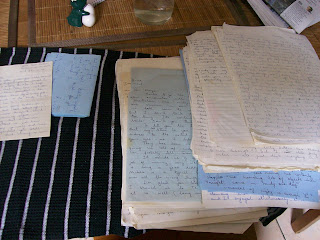
My mother had seriously amazing grammar and punctuation skills, probably even better than MC Grammar.
So that's the deal about me, I got it from my momma.
Recently I found a whole pile of my mother's letters, dated from 1980 to 1982. She died a few years ago, so I took them home to read them and hear what she was up to in the early 80's, apart from having the perm of a god. And let me tell you, these letters revealed something fascinating about her.

My mother had seriously amazing grammar and punctuation skills, probably even better than MC Grammar.
So that's the deal about me, I got it from my momma.
Sunday, 19 December 2010
'A' and 'An': the blog post we had to have.
I would like to apologise to you, my multi-talented and sexy readers. The last couple of months have been lost time – they have been snatched away, never to be rescued from the jaws of the past. But believe me when I say it couldn't be helped. You see, I bought a trampoline.
Who knew how much joy you could get out of springing into the air and spreading your legs as wide as they can go, then feeling the air running through your hair as you plummet back down to earth? And when you wear balloon pants like I do, the experience quadruples in fun. I have been jumping on my trampoline, feeling the wind rush past my ears for weeks and weeks now.
And this brings us to our post today: the question of using An or A.
A is known as the indefinite article. Indefinite articles mean that we are not talking about a specific thing. For example, if you say, a cat, we can't be sure which cat is being talked about exactly. If you say the cat, it means that you are talking about a particular cat.
An is also an indefinite article, and is for when a word starts with a vowel, like 'an elephant'.
Simple enough. But like many things on the hard streets of grammar, you have to be always on your toes. The moment you get comfortable, the moment you get a little too big for your boots is the moment when they cut you down to size.
And this is exactly what happens when you come find yourself writing out something like 'an SES volunteer', or 'an LED light'. You're all 'hey! S and L are not vowels! Why are you using an?!'
It's true, S and L are not vowels. And without a doubt, if these acronyms were spelt out as 'state emergency service' and 'light-emitting diode', you would definitely say 'a state emergency service volunteer' and 'a light-emitting diode', but the thing is, in most cases, written language follows the way we speak as closely as it can. When you say 'SES' the letter S starts off with a sound like 'EH' or 'AH', so it's kind of exhausting to say 'a SES volunteer', because you spend all the oxygen you have on you at the time, just trying to say 'a', because you've got no smooth segue into saying 'SES'. You end up running out of breath and collapsing on the floor, clutching at your throat and thrashing your legs around in panic.
To avoid this this, it's easier to say 'an SES volunteer' because that way, you just spring effortlessly from your article to your noun like a kangaroo on a trampoline underneath another trampoline.
The letters that need the article 'an' in front of them when they're in acronyms are the ones that are a bit hard to say, which is F, L,M,N,R and S. So if you're ever in doubt about what to write, just say it out loud and see if you throw the old an in there. If it's good enough to say, it's good enough to write on paper.
Who knew how much joy you could get out of springing into the air and spreading your legs as wide as they can go, then feeling the air running through your hair as you plummet back down to earth? And when you wear balloon pants like I do, the experience quadruples in fun. I have been jumping on my trampoline, feeling the wind rush past my ears for weeks and weeks now.
And this brings us to our post today: the question of using An or A.
A is known as the indefinite article. Indefinite articles mean that we are not talking about a specific thing. For example, if you say, a cat, we can't be sure which cat is being talked about exactly. If you say the cat, it means that you are talking about a particular cat.
An is also an indefinite article, and is for when a word starts with a vowel, like 'an elephant'.
Simple enough. But like many things on the hard streets of grammar, you have to be always on your toes. The moment you get comfortable, the moment you get a little too big for your boots is the moment when they cut you down to size.
And this is exactly what happens when you come find yourself writing out something like 'an SES volunteer', or 'an LED light'. You're all 'hey! S and L are not vowels! Why are you using an?!'
It's true, S and L are not vowels. And without a doubt, if these acronyms were spelt out as 'state emergency service' and 'light-emitting diode', you would definitely say 'a state emergency service volunteer' and 'a light-emitting diode', but the thing is, in most cases, written language follows the way we speak as closely as it can. When you say 'SES' the letter S starts off with a sound like 'EH' or 'AH', so it's kind of exhausting to say 'a SES volunteer', because you spend all the oxygen you have on you at the time, just trying to say 'a', because you've got no smooth segue into saying 'SES'. You end up running out of breath and collapsing on the floor, clutching at your throat and thrashing your legs around in panic.
To avoid this this, it's easier to say 'an SES volunteer' because that way, you just spring effortlessly from your article to your noun like a kangaroo on a trampoline underneath another trampoline.
The letters that need the article 'an' in front of them when they're in acronyms are the ones that are a bit hard to say, which is F, L,M,N,R and S. So if you're ever in doubt about what to write, just say it out loud and see if you throw the old an in there. If it's good enough to say, it's good enough to write on paper.
Subscribe to:
Posts (Atom)